


Mrinal K. Sarkar
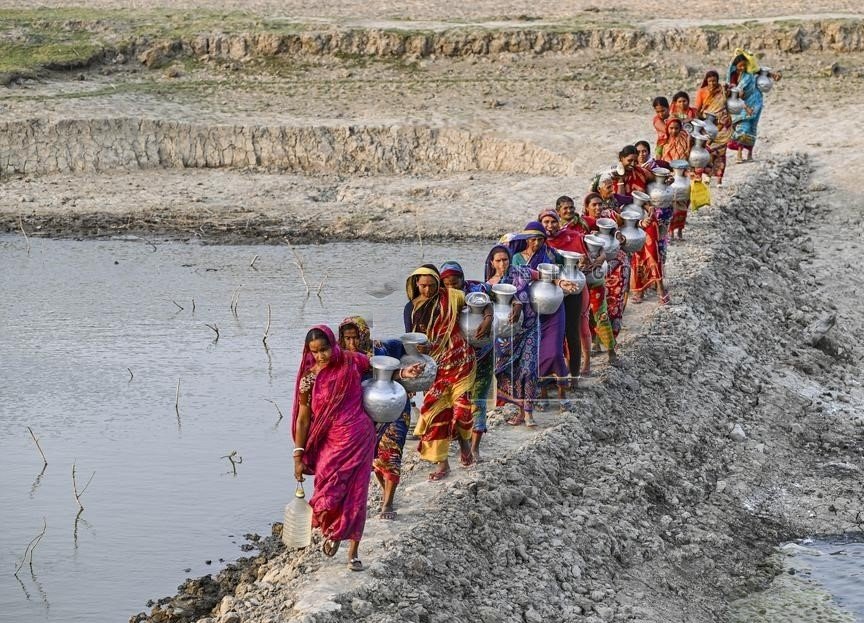
Water security is currently a hot topic. Although three-fourths (70%) of the earth’s surface is covered with water, about 40% of the world’s population suffers from water insecurity in one way or another and its level will increase in the future. The position of living beings without water is rare. Suppose you print an office letter after typing, if the paper you use is A4, you have indirectly used about 10 liters of water, which is used to make just one A4 paper. About 50-75% of the human body is water. Therefore, water is the driving force of life and one of the main components of all development. A person can live for about 40 days by drinking water alone, while a person cannot live for 5 days without water. Therefore, water is the source of all living beings and another name for water is life. Water security and the dangers associated with it vary from place to place, time to time. For a housewife, water security means the proper supply and quality of water used in the home. On the other hand, for a farmer, water security means the proper supply and quality of water available to farmers to grow crops. In urban life, during a water crisis, the level of water insecurity or vulnerability for a resident of the ground floor of a multi-storey building is different from that of a resident living above the 10th floor. Therefore, water security refers to the proper supply of quality water required by people living in a particular place and at a particular time for drinking water, health, food security, socio-economic development and, above all, environmental balance. Although water-related disasters and dangers are currently being addressed in the analysis of water security, the issue of water insecurity in least developed and developing countries are not given importance. Again, although water security is sometimes a major consideration in national and international development policies, the issue is often neglected in the socio-economic and political context of the country.
As a result, water crisis is becoming more and more evident in the least developed and developing countries. Due to increasing population growth, food security for the growing population, socio-economic development (urbanization and changes in eating habits), etc., the level of water use (direct or indirect use) is increasing day by day. Climate change and human-caused pollution levels are constantly turning our water resources into waste water. Therefore, it is very important to realize the issue of water insecurity at the individual level.
In fact, sea water is the only source of all our water. Sea water first enters the atmosphere through the water cycle (atmosphere-water cycle), then from the atmosphere it falls as rain, then it enters the ground and enters the ground. Finally, the water on our surface and underground goes back to the sea through various processes and reunites with the sea, completing a complete water cycle. According to the World Meteorological Organization (WMO), the total volume of water on Earth is approximately 1.4 billion cubic kilometers, of which 97.5% is salt water and 2.5% (35 million cubic kilometers) is freshwater. But the limitation is that out of only 2.5% of the world’s fresh water, 70% of it is stored as glaciers or ice in mountainous areas, Antarctica and the Arctic, which are not suitable for human use, and the remaining 30% of fresh water is stored in groundwater, river water, soil moisture and the atmosphere. As a percentage, the total amount of fresh water above the ground on earth is only about 0.3% or about 105,000 cubic kilometers. The amount of water in the atmosphere is 13,000 cubic kilometers (about 100,000 cubic kilometers). Therefore, in terms of quality and quantity, the amount of usable water on earth is less than 1% of the total water on earth and the rest of the world. The total amount of water on earth is salt water 97.5% and fresh water 2.5%. Currently, about 40% of the people in the world are facing water shortages.
There are three sources of fresh water in Bangladesh: a) international rivers b) rainwater and c) groundwater. Among the international rivers, the Padma, Jamuna and Meghna are the three largest rivers, with a basin area of about 1.72 million km2 (Padma 1087000 sq km, Brahmaputra/Jamuna 553000 sq km and Meghna 82000 sq km). Only 7% of the basin area of our international rivers is within the borders of Bangladesh. Although rainwater is one of our main sources, this water is not used much except for agricultural work. Due to the excessive water crisis in the southern region, about 26% of the people currently use rainwater. Especially for people in coastal areas, rainwater is the only source of drinking water. There is a need for special awareness among people about harvesting and drinking this rainwater. For this, various initiatives are being taken by the government and the private sector, which are needed more and more.
In all situations, water insecurity or water-related problems can be divided into three categories. For example: 1) water scarcity, which we call drought or water scarcity, 2) excess water, which we call flood or waterlogging, and 3) dirty or polluted water, which we call water pollution. Although it is estimated that the amount of usable fresh water on earth is less than 1%, the pollution level of surface freshwater sources is increasing day by day due to natural and human-induced reasons.
This concept paper is mainly for awareness purposes. Information published by various national and international organizations in various media has been used to prepare the concept paper. I hope it will be helpful in increasing the water awareness of the readers at different levels.
Writer is a development worker having more than 18 years of experiences and performing in the field of climate change adaption, locally led adaptation with effective engaging of youth, agriculture value chain and market development. Besides, experiences in the field of Water, Sanitation and Hygiene (WASH) for urban settlement areas along with entrepreneurship development.
Mrinal K. Sarkar is a development professional having more than 18 years of experience performing in the field of climate change adaptation, locally led adaptation with effective engagement of youth. Besides, experience in the field of Water, Sanitation, and Hygiene (WASH) for urban settlement areas along with entrepreneurship development.